
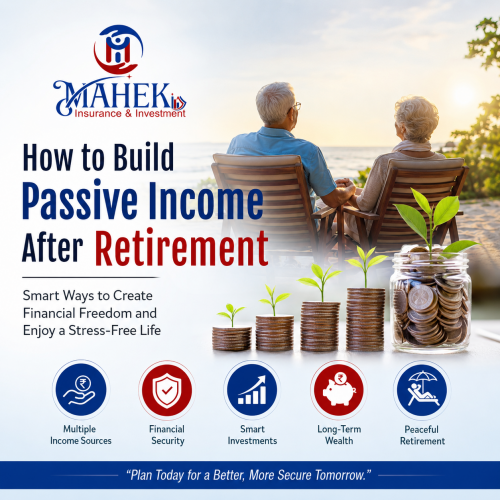
How to Build Passive Income After Retirement
Retirement should not mean the end of financial independence. In fact, retirement is the stage of life when having a steady and reliable income stream becomes more important than ever.
When your salary or business income stops, your regular expenses continue—and some expenses, such as healthcare and lifestyle costs, may increase. This is why retirement planning should focus not only on building a retirement corpus, but also on turning that corpus into sustainable income.
What Is Passive Income After Retirement?
Passive income is money you receive regularly without having to actively work for it every day.
For retirees, potential sources can include:
- Interest income from suitable fixed-income investments
- Pension or annuity income
- Rental income from property
- Dividends from eligible investments
- Systematic withdrawals from an appropriately planned investment portfolio
- Income from other assets built during working years
The right combination depends on your age, financial goals, risk tolerance, existing assets and income requirements.
1. Start by Calculating Your Retirement Income Requirement
Before choosing an investment or income product, estimate how much monthly income you may need.
Consider:
Essential Expenses + Lifestyle Expenses + Healthcare + Emergency Provision
Also account for inflation. ₹50,000 per month today may not have the same purchasing power 10–20 years from now.
A good retirement plan therefore asks two questions:
“How much corpus will I need?”
and
“How can I generate regular income from that corpus?”
2. Create Multiple Income Sources
Depending entirely on one source of retirement income can create unnecessary financial pressure.
A diversified retirement-income strategy may combine different sources such as:
Pension / Annuity Income
An annuity can be structured to provide regular income, depending on the product and option selected.
Interest Income
Certain fixed-income instruments can provide periodic interest, subject to their terms, taxation and applicable risks.
Rental Income
Property can potentially generate regular rental income, although vacancy, maintenance, taxation and liquidity should be considered.
Investment Portfolio Withdrawals
A carefully structured portfolio may allow planned withdrawals while keeping part of the corpus invested for future needs.
The objective is not simply to maximize returns—it is to create sustainable and dependable retirement cash flow.
3. Protect Your Retirement Corpus
One of the biggest retirement mistakes is taking excessive investment risk because you want higher returns.
At the same time, keeping the entire retirement corpus in very low-return assets can expose you to inflation risk.
A balanced approach can help you manage:
Growth + Stability + Liquidity + Income
Your retirement strategy should gradually become more focused on protecting your financial independence as your retirement date approaches.
4. Keep an Emergency Fund
Retirement income planning should always include a separate emergency reserve.
Unexpected expenses can arise from:
- Medical emergencies
- Home repairs
- Family responsibilities
- Major lifestyle expenses
- Unexpected financial commitments
Having readily accessible funds can prevent you from being forced to sell long-term investments at an unfavorable time.
5. Plan for Inflation
Inflation is one of the biggest threats to retirement income.
For example, if your expenses are ₹60,000 per month today, the amount required after 15 or 20 years could be considerably higher.
Therefore, retirement planning should not only target today's income requirement. It should also consider how your income needs may increase over time.
6. Review Your Retirement Plan Regularly
Your retirement plan should not be a one-time decision.
Review it periodically based on:
- Changes in expenses
- Investment performance
- Inflation
- Tax rules
- Health and family requirements
- Changes in your retirement goals
- Changes in income sources
Regular reviews can help keep your retirement strategy aligned with your actual financial situation.
Build Retirement Income Before You Retire
The best time to create passive income is before retirement, not after your regular income has stopped.
Starting early gives you more time to build your corpus and allows you to plan your income sources gradually.
A Simple Retirement Income Framework
Step 1: Estimate your future retirement expenses
↓
Step 2: Calculate the required retirement corpus
↓
Step 3: Build the corpus systematically
↓
Step 4: Diversify your retirement-income sources
↓
Step 5: Protect liquidity and emergency funds
↓
Step 6: Review and adjust the plan regularly
Final Thoughts
A financially comfortable retirement is not just about having a large amount of money saved. It is about having a well-planned income strategy that can support your lifestyle for the years ahead.
The goal should be simple:
Build your retirement corpus today.
Create reliable income for tomorrow.
Protect your financial independence for life.
At MAHEK INSURANCE & INVESTMENT, Rajendra Solanki, IRDA Registered Insurance Advisor, helps clients understand their retirement goals and explore suitable retirement income, protection and long-term financial planning options based on their individual needs.
Start your retirement-income planning today—because your future income deserves today's planning.
